After World War II
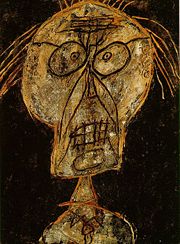
Jean Dubuffet,
Dhôtel nuancé d’abricott, 1947, Pompidou Center, Paris
The Post war period left the capitals of Europe in upheaval with an urgency to economically and physically rebuild and to politically regroup. In Paris (the former center of European culture and the former capital of the art world) the climate for art was a disaster. Important collectors, dealers, and modernist artists, writers, and poets had fled Europe for New York and America. The Surrealists, and modern artists from every cultural center of Europe had fled the onslaught of the Nazis for safe haven in the United States. Many of those that didn't flee perished. A few artists, notably Pablo Picasso, Henri Matisse, and Pierre Bonnard, remained in France and survived.
In Europe after the war there was the continuation of Surrealism, Cubism, Dada and the works of Matisse. Also in Europe, Art brut, and Tachisme (the European equivalent to Abstract expressionism) took hold of the newest generation. Serge Poliakoff, Nicolas de Staël, Georges Mathieu, Vieira da Silva, Jean Dubuffet, Yves Klein and Pierre Soulages among others are considered important figures in post-war European oil painting.
[edit] Pollock, Krasner, Hofmann
The 1940s in New York City heralded the triumph of American Abstract expressionism, a modernist movement that combined lessons learned from Henri Matisse, Pablo Picasso, Surrealism, Joan Miró, Cubism, Fauvism, and early Modernism via great teachers in America like Hans Hofmann from Germany and John D. Graham from Russia. Graham's influence on American art during the early 1940s was particularly visible in the work of Arshile Gorky, Willem de Kooning and Jackson Pollock. American artists also benefited from the presence of Piet Mondrian, Fernand Leger, Max Ernst and the André Breton group, Pierre Matisse's gallery, and Peggy Guggenheim's gallery The Art of This Century, as well as other factors. Hans Hofmann in particular as teacher, mentor and artist was both important and influential to the development and success of Abstract Expressionism in the United States. Among Hofmann's protege's was Clement Greenberg who became an enormously influential voice for American oil paintings and among his students was Lee Krasner who introduced her teacher Hans Hofmann to Jackson Pollock her husband.
[edit] Pollock and Abstract influences
During the late 1940s Jackson Pollock's radical approach to oil painting revolutionized the potential for all Contemporary art that followed him. To some extent Pollock realized that the journey toward making a work of art was as important as the work of art itself. Like Pablo Picasso's innovative reinventions of painting and sculpture near the turn of the century via Cubism and constructed sculpture, Pollock redefined what it was to produce art . His move away from easel oil paintings and conventionality was a liberating signal to the artists of his era and to all that came after. Artists realized that Jackson Pollock's process—the placing of unstretched raw canvas on the floor where it could be attacked from all four sides using artist materials and industrial materials; linear skeins of paint dripped and thrown; drawing, staining, brushing; imagery and non-imagery—essentially blasted artmaking beyond any prior boundary. Abstract expressionism in general expanded and developed the definitions and possibilities that artists had available for the creation of new works of art.
The other Abstract expressionists followed Pollock's breakthrough with new breakthroughs of their own. In a sense the innovations of Jackson Pollock, Willem de Kooning, Franz Kline, Mark Rothko, Philip Guston, Hans Hofmann, Clyfford Still, Barnett Newman, Ad Reinhardt, Richard Pousette-Dart, Robert Motherwell, Peter Voulkos and others opened the floodgates to the diversity and scope of all the art that followed them. Rereadings into abstract art, done by art historians such as Linda Nochlin, Griselda Pollock and Catherine de Zegher critically shows, however, that pioneer women artists who have produced major innovations in modern art had been ignored by the official accounts of its history.
[edit] Action painting and Color field
The style was widespread from the 1940s until the early 1960s, and is closely associated with abstract expressionism (some critics have used the terms action painting and abstract expressionism interchangeably). A comparison is often drawn between the American action painting and the French tachisme.
The term was coined by the American critic Harold Rosenberg in 1952 and signaled a major shift in the aesthetic perspective of New York School painters and critics. According to Rosenberg the canvas was "an arena in which to act". While abstract expressionists such as Jackson Pollock, Franz Kline and Willem de Kooning had long been outspoken in their view of a painting as an arena within which to come to terms with the act of creation, earlier critics sympathetic to their cause, like Clement Greenberg, focused on their works' "objectness." To Greenberg, it was the physicality of the paintings' clotted and oil-caked surfaces that was the key to understanding them as documents of the artists' existential struggle.
Rosenberg's critique shifted the emphasis from the object to the struggle itself, with the finished painting being only the physical manifestation, a kind of residue, of the actual work of art, which was in the act or process of the painting's creation. This spontaneous activity was the "action" of the painter, through arm and wrist movement, painterly gestures, brushstrokes, thrown paint, splashed, stained, scumbled and dripped. The painter would sometimes let the paint drip onto the canvas, while rhythmically dancing, or even standing in the canvas, sometimes letting the paint fall according to the subconscious mind, thus letting the unconscious part of the psyche assert and express itself. All this, however, is difficult to explain or interpret because it is a supposed unconscious manifestation of the act of pure creation.
Abstract expressionism has an image of being rebellious, anarchic, highly idiosyncratic and, some feel, rather nihilistic. In practice, the term is applied to any number of artists working (mostly) in New York who had quite different styles, and even applied to work which is not especially abstract nor expressionist. Pollock's energetic action paintings, with their "busy" feel, are different both technically and aesthetically, to the violent and grotesque Women series of Willem de Kooning. (As seen below in the gallery) Woman V is one of a series of six paintings made by de Kooning between 1950 and 1953 that depict a three-quarter-length female figure. He began the first of these paintings, Woman I, collection: The Museum of Modern Art, New York City, in June 1950, repeatedly changing and painting out the image until January or February 1952, when the painting was abandoned unfinished. The art historian Meyer Schapiro saw the painting in de Kooning's studio soon afterwards and encouraged the artist to persist. De Kooning's response was to begin three other paintings on the same theme; Woman II, collection: The Museum of Modern Art, New York City, Woman III, Tehran Museum of Contemporary Art, Woman IV, Nelson-Atkins Museum of Art, Kansas City, Missouri. During the summer of 1952, spent at East Hampton, de Kooning further explored the theme through drawings and pastels. He may have finished work on Woman I by the end of June, or possibly as late as November 1952, and probably the other three women pictures were concluded at much the same time. The Woman series are decidedly figurative paintings. Another important artist is Franz Kline, as demonstrated by his painting Number 2, 1954 (see above) as with Jackson Pollock and other Abstract Expressionists, was labelled an "action painter because of his seemingly spontaneous and intense style, focusing less, or not at all, on figures or imagery, but on the actual brush strokes and use of canvas.
Automatic writing was an important vehicle for action painters Franz Kline in his black and white paintings, Jackson Pollock, Mark Tobey and Cy Twombly who used gesture, surface, and line to create calligraphic, linear symbols and skeins that resemble language, and resonate as powerful manifestations from the collective unconscious. [4] Robert Motherwell in his Elegy to the Spanish Republic series also painted powerful black and white paintings using gesture, surface and symbol evoking powerful emotional charges.
While other action painters notably Willem de Kooning, Arshile Gorky Norman Bluhm, Joan Mitchell, and James Brooks (painter) (see gallery) used imagery via either abstract landscape or as expressionistic visions of the figure to articulate their highly personal and powerful evocations. James Brooks' oil paintings were particularly poetic and highly prescient in relationship to Lyrical Abstraction that became prominent in the late 1960s and the 1970s.
Clyfford Still, Barnett Newman, Adolph Gottlieb (see gallery) and the serenely shimmering blocks of color in Mark Rothko's work (which is not what would usually be called expressionist and which Rothko denied was abstract), are classified as abstract expressionists, albeit from what Clement Greenberg termed the Color field direction of abstract expressionism. Both Hans Hofmann (see gallery) and Robert Motherwell (gallery) can be comfortably described as practitioners of action painting and Color field painting. In the 1940s Richard Pousette-Dart's tightly constructed imagery often depended upon themes of mythology and mysticism; as did the paintings of Adolph Gottlieb, and Jackson Pollock in that decade as well.
Color Field painting initially referred to a particular type of abstract expressionism, especially the work of Mark Rothko, Clyfford Still, Barnett Newman, Robert Motherwell, Adolph Gottlieb Ad Reinhardt and several series of paintings by Joan Miró. Art critic Clement Greenberg perceived Color Field painting as related to but different from Action oil painting. The Color Field painters sought to rid their art of superfluous rhetoric. Artists like Robert Motherwell, Clyfford Still, Mark Rothko, Adolph Gottlieb, Hans Hofmann, Helen Frankenthaler, Sam Francis, Mark Tobey (see gallery) and especially Barnett Newman (see below) and Ad Reinhardt used greatly reduced references to nature, and they painted with a highly articulated and psychological use of color. In general these artists eliminated recognizable imagery. In the case of Rothko and Gottlieb sometimes using symbol and sign as replacement of imagery. Certain artists quoted references to past or present art, but in general color field painting presents abstraction as an end in itself. In pursuing this direction of modern art, artists wanted to present each oil painting as one unified, cohesive, monolithic image.
In distinction to the emotional energy and gestural surface marks of Abstract Expressionists such as Jackson Pollock and Willem de Kooning, the Color Field painters initially appeared to be cool and austere, effacing the individual mark in favor of large, flat areas of color, which these artists considered to be the essential nature of visual abstraction, along with the actual shape of the canvas, which later in the 1960s Frank Stella in particular achieved in unusual ways with combinations of curved and straight edges. However Color Field painting has proven to be both sensual and deeply expressive albeit in a different way from gestural Abstract expressionism.
Although Abstract expressionism spread quickly throughout the United States, the major centers of this style were New York City and California, especially in the New York School, and the San Francisco Bay area. Abstract expressionist oil paintings share certain characteristics, including the use of large canvases, an "all-over" approach, in which the whole canvas is treated with equal importance (as opposed to the center being of more interest than the edges. The canvas as the arena became a credo of Action oil painting, while the integrity of the picture plane became a credo of the Color field painters.
[edit] In the 1960s after abstract expressionism
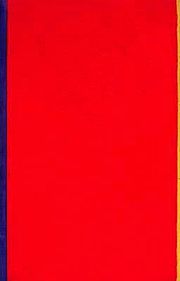
Barnett Newman,
Who's Afraid of Red, Yellow and Blue?, 1966. Typical of Newman's later work, with the use of pure and vibrant color.
Main articles: Post-painterly abstraction, Color Field painting, Lyrical Abstraction, Arte Povera, Process Art, Minimal art, Postminimalism, and Western painting
In abstract oil painting during the 1950s and 1960s several new directions like Hard-edge oil paintings and other forms of Geometric abstraction, as a reaction against the subjectivism of Abstract expressionism began to appear in artist studios and in radical avant-garde circles. Clement Greenberg became the voice of Post-painterly abstraction; by curating an influential exhibition of new oil painting that toured important art museums throughout the United States in 1964. Color field oil painting, Hard-edge painting and Lyrical Abstraction emerged as radical new directions.
 Abstract expressionism Art critics of the post-World War II era
