


Made in Imperial China
AMSTERDAM.- Sotheby��s is delighted to announce that early next year, on Tuesday 30th and Wednesday 31st January 2007, its Amsterdam salerooms will mount a sale of one of the largest and most evocative shipwreck salvage operations ever staged. Estimated to realise a sum in excess of �2 million, the sale will bring to the market over 76,000 pieces of fine Chinese porcelain dating from about 1725 �C all of which have for centuries lain lost and forgotten in the waters of the South China Sea. Among the tens of thousands of pieces to be offered are vast quantities of all manner of wares �C everything from fine blue and white tea services, to porcelain boxes and beer mugs, to delightful polychrome figures. This extensive hoard will be offered in some 1500 lots, with estimates ranging from �100 to �10,000. Proceeds from the sale will be used by the Vietnamese government to fund further salvage operations, and to provide necessary research and display facilities for the items it has retained.
Thanks to the inclusion of pieces bearing the mark of Emperor Yongzheng (who reigned for just 14 years), the date at which the ship (a Chinese junk) sank can be put to somewhere between 1723 and 1736. It seems that fire was the cause of the disaster, and that the flames on board were so ferocious they not only caused the junk to sink, but also caused some of the porcelain on board to warp and fuse together. The resulting ��marine sculptures�� bear dramatic testimony to the intense heat that must have engulfed the ship at the time.
Despite this dramatic history, and a subsequent 280 years on the seabed, the condition of the pieces is remarkably good �C a consequence, no doubt, of their inherent quality: the vast majority of the pieces having been made at the kilns of Jingdezhen1 - the city where all the Chinese Imperial porcelain was produced and the place, therefore, associated with the finest of Chinese porcelain.
Pieces from the vast cargo first emerged from the waters in 1998, hauled up in the nets of local Vietnamese fishermen. News of the fishermen��s illegal dredging for artefacts was eventually printed in a local newspaper and the Vietnamese Government swiftly mounted a full-scale operation to recover the cargo from the sea and from the fishermen. The process was long and arduous �C adverse weather conditions, strong currents and technical problems hampered progress - but after two years of concentrated efforts by a Vietnamese team of divers, conservators and scholars the last remains of the cargo were finally recovered from the waters, and then the story of the boat - and the fascinating chapter of history of which it was a part - began to come to life2.
The route the junk was taking at the time of the fire was that taken by so many other similar boats of the period. Discovered off the coast of Vietnam, south of the Ca Mau peninsula near the Mekong river delta, experts have deduced that the boat was on its way from Canton (present day Guangzhou) to Batavia (now Jakarta). China was then largely closed to foreign trade, but because of the enormous demand for tea, silk and its fine white porcelain, a tightly controlled trading port for Westerners was opened at Canton. From the moment it opened, the port at Canton enormously busy, serving not only English, Dutch, Scandinavian, French and Armenian traders, but also vast numbers of Chinese junks which would then ferry quantities of trade goods, including porcelain, to ports in the South China Sea. From there the cargoes would be sold and shipped on the long journey round Africa back to Europe or out to the Middle East.
The Ca Mau cargo provides a compelling insight into this vigorous export trade. From the shapes and patterns of the pieces found on board, it is clear that the porcelain was destined for Europe. European motifs recur, including �C for example �C a number of charming depictions of European landscapes peopled with figures in European dress (some of the landscapes are almost identifiable, reminiscent of the Dutch towns of Scheveningen and Gothenburg). Similarly, European shapes are clearly evident in pieces such as the porcelain beer mugs found on board. The overwhelming majority of the pieces found on board, though, relate to tea-drinking, the craze for which - together with that for coffee and chocolate - was then sweeping through Europe like wild fire.
The date of the shipwreck coincides with the earliest years of porcelain making in Europe and the influence that such Chinese porcelain had on the passionate porcelain collectors of the day, such as Augustus the Strong, is obvious. While much of the porcelain found on the boat was produced in the Imperial kilns of Jingdezhen, a number of pieces from the Dehua kiln complex were also found in the cargo. These include polychrome painted figures, such as ewers in the form of a monkey, which were clearly the inspiration for some of pieces later produced at Meissen and in Dutch Delft. Augustus the Strong was not alone in his compulsive fascination with Chinese porcelain. Across Europe kings, noblemen and those who could afford it set aside entire rooms in their homes and palaces in which to display their Oriental wares �C wares for which they would have paid extremely high prices. These they would have bought primarily at auctions in Amsterdam or London or from a network of dealers, often women, travelling throughout the continent.
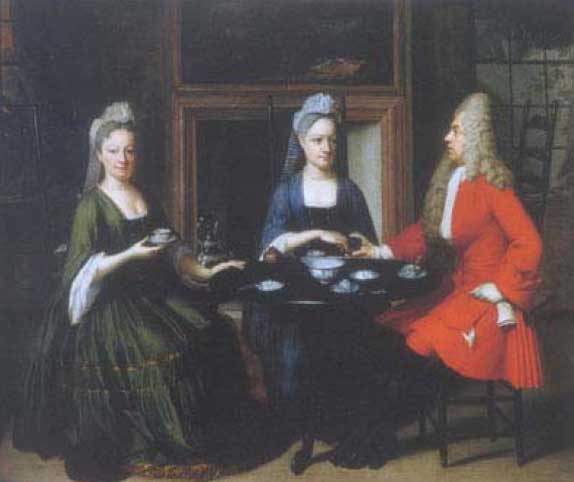
The passion for blue and white wares was not, however, confined to the nobility. It was equally strong across the social spectrum, and particularly as a means to service the then insatiable appetite in Europe for tea, coffee and chocolate. By 1725 tea, coffee and chocolate were all the rage in England. In London, with a population of only one million there were said to be no fewer than 1500 Coffee Houses. Tea was the major beverage served in the coffee houses, but they were so named because coffee arrived in England some years before tea. Exclusively for men, they were called "Penny Universities" because for a penny any man could obtain a pot of tea, a copy of the newspaper, and engage in conversation with the sharpest wits of the day. The various houses specialized in selected areas of interest, some serving attorneys, some authors, others the military.
They were the forerunner of the English gentlemen''''s private club. One such beverage house was owned by Edward Lloyd and was favoured by shipowners, merchants and marine insurers. That simple shop was the origin of Lloyd''''s, the worldwide insurance firm. Attempts to close the coffee houses were made throughout the 18th century because of the free speech they encouraged, but such measures proved so unpopular they were always quickly revoked.
The records of the East India company show that in the 1720s, tea was the primary cargo on the East India company ships involved with the China trade. With it came the hundreds of thousands of tea wares that were imported each year from which to drink it. England and the Netherlands were the prime importers but the popularity of tea and coffee drinking meant that ships from Scandinavia, France, the Austrian Netherlands, Spain, Portugal and even Armenia were all involved in the trade to meet the demand from across the continent. Even the high feelings which resulted in the Boston Tea Party acts as a potent reminder of the ever-increasing demand.
Aside from tea and tea-drinking wares, silk was the other Eastern commodity that was much in demand in Europe in the 18th century. These three commodities were regularly shipped together, the porcelain acting as ballast at the bottom of the boat, then the tea and the silk on top of it all. No doubt the recently discovered junk had also been carrying tea and silk, but these would have perished on the seabed. Only the porcelain and some other resilient artefacts3 remained. Although it is now some 280 years old.