


by Marguerite (French, 1761-1837)
Oil on canvas
Oil on canvas
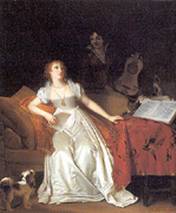
By the early 1780s Marguerite was producing numerous paintings of well-to-do women making music-taking instrumental lessons or, as here, rehearsing for an informal concert. On one level, such scenes, inspired by seventeenth-century Dutch models, simply acknowledge the fact that marriageable young ladies of the time were expected to acquire a certain degree of accomplishment in the various social arts, music chief among them. However, recent scholarship has emphasized the traditional link between painted images of music making and physical love. Here, for example, the female singer-clad in the same sumptuous white satin gown worn by many of Marguerite'''''''''''''''' other female subjects-pauses to look up, her expression (and her body language) seeming to signify surprise, perhaps in response to a romantic overture from her male accompanist, standing behind the sofa.
Other erotic overtones may also be symbolized by the contrast between the small dog (a traditional emblem of fidelity) standing alert at the left beside the singer, and the cat (often used to represent sexual promiscuity), eyes bright and tail upraised, apparently ready to pounce from the other side of the painting. Moreover, the guitar has often been compared to the female form. This particular instrument is typical of European guitars from the eighteenth and nineteenth centuries. Smaller than the modern guitar, it has a flat bottom, a decorative rosette set into the sound hole, and only five (versus the now common six) strings.