


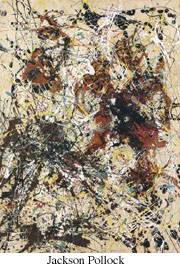
Often credited as the first uniquely American style, Abstract Expressionism is a movement that developed in American painting during the 1940s and 1950s, and at that time generally referred to all types of non-geometric abstraction. It was the first American visual art to gain international status and influence. The term, commonly associated with post-war American art, was first used in 1946 by an American critic, in referring to the work of Arshile Gorky (1904-1948), Jackson Pollock (1912-1956) and Willem de Kooning (1904-1997).
Abstract Expressionism does not describe a style as much as it does an attitude. Its roots are in European Neo-Expressionism, which came across the ocean with expatriate avant-garde artists such as Marcel Duchamp (1887-1968) who fled Nazi Germany for New York City and Hans Hofmann (1880-1966), who became a chief exponent as painter and teacher in America of Abstract Expressionism. Many post-war American artists felt weary of European-linked art such as Impressionism and Classicism, and sought new directions. Typically these new artists applied paint rapidly in an effort to show feelings and emotion. Not all of their art was abstract or expressive, but they felt that through spontaneity they would release the creativity of their subconscious minds. Abstract Expressionist artists were influenced by Existentialist ideas, which emphasized the importance of the act of creating, not of the finished object.
Because of the geographical concentration of first-generation Abstract Expressionist artists who lived within a well-defined region of New York Cityand, exponents are also known as the New York School, and the city was the center of Abstract Expressionist art after World War II. This circumstance was partly because large numbers of European artists had come to live there as refugees. New York had also became the center for young Americans returning from military service who were anxious to continue with their artistic careers. The only real connection between these artists was their philosophy, which valued individuality and improvisation, and their effort to express their subconscious through their art, as a commentary on contemporary society after the Depression and World War II. Many of these painters and sculptors showed their work in exhibitions held at the 9th Street Gallery in 1951, followed by New York School Annuals at the Stable Gallery, and some were well received, albeit controversial. Nelson Rockefeller is said to have purchased over 2,500 pieces of Abstract Expressionist art. (Shark)
While post-World War II painters including Jackson Pollock, Willem DeKooning, and Robert Motherwell (1915-1991) shared the spotlight, the era''''s sculptors received only modest critical and popular acclaim. However sculptors such as Seymour Lipton (1903-1986), Theodore Roszak (1907-1981), Herbert Ferber (1906-1991), David Smith (1906-1965), and Isamu Noguchi (1904-1988) shared the intellectual roots and experiential culture of war that characterized the movement. Smith, Roszak and Lipton worked especially in metal, which meant that their art could not be produced as fast as oil paintings, and that limitation of spontanaity may be one reason why sculptors are often overlooked in discussions of Abstract Expressionist art.
After World War II, the Congress for Cultural Freedom, and the Museum of Modern Art in New York supported exhibitions of Abstract Expressionist artworks and the work of these American artists was also exhibited in museums of Europe. The size of their canvases was striking and disturbing to some. At a Congress for Cultural Freedom exhibit in Barcelona the oil paintings were so large the museums metal doors had to be sawed off in order to get the oil paintings through. In La Libre Belgique it was written: "The Biggest in the WorldThis strength, displayed in the frenzy of a total freedom, seems a really dangerous tide. Our own abstract painters seem pygmies before the disturbing power of these unchained giants. (Shark)
With continuing popularity today, the style of Abstract Expressionism is emotion and energy driven, and explores mediums, lines, shapes, colors, and texture.
Abstract Expressionism is no longer regarded as leading edge, having been replaced by a variety of other isms, but many artists reflecting that style continue to be some of the most recognized in the art market today. Other participating artists remain little known for a variety of reasons including abandonment of the style, little marketing promotion, racial discrimination and inability to get gallery exhibition space. The artist list accompanying this essay reflects the better and lesser-known early Abstract Expressionists including some who totally turned away from the style.